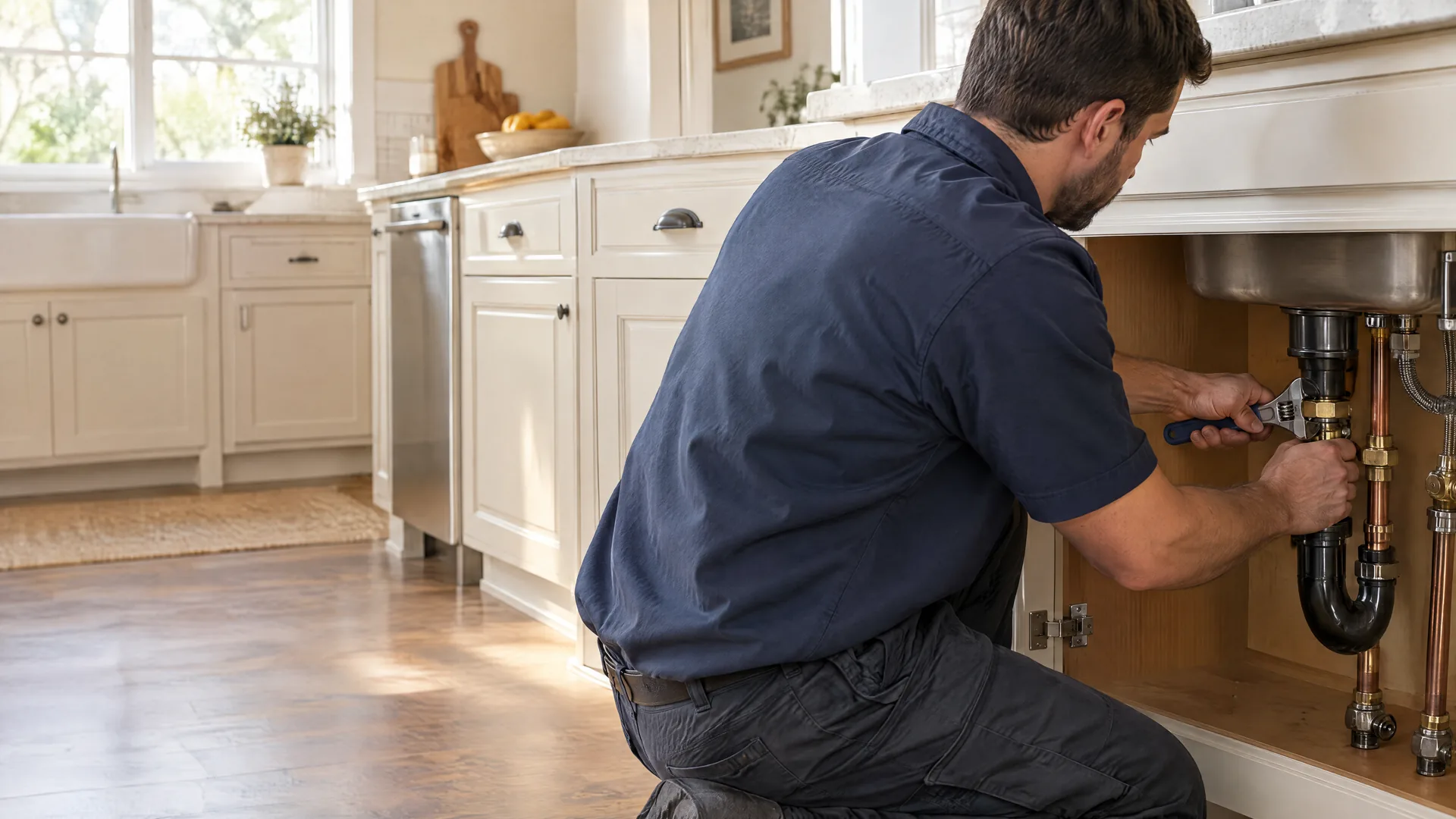
A tankless water heater in Yoakum, TX that suddenly delivers lukewarm showers is usually not broken. It is being asked to do something it cannot do under current conditions, and the reason is almost always flow, scale, or gas. Unlike a storage tank, a tankless water heater makes hot water only while water is moving through it, so everything about its performance depends on what is happening at that moment. Once you know how the unit decides to fire and how hot to run, the cold shower stops being a mystery. Here is the mechanism and the short list of causes we find most.
How a Tankless Water Heater Decides to Fire
Open a hot tap and water starts moving through the unit. A flow sensor detects that movement and tells the control board to light the burner. Incoming water passes through a heat exchanger, a coiled metal path sitting directly in the flame, and comes out hot on the other side.
The control board is doing constant math. It reads the incoming water temperature, reads the flow rate, and modulates the burner to hit your set temperature. That math is the key to almost every complaint. The unit can only raise water a certain number of degrees at a certain flow rate, which manufacturers publish as a temperature rise chart. ENERGY STAR publishes efficiency information on certified tankless gas models.
The Minimum Flow Rate Problem
Every tankless water heater has a minimum activation flow rate. Below it, the flow sensor never tells the burner to light, and you get straight cold water.
This is why a trickling bathroom faucet runs cold while a full shower runs hot. It is also why the problem often appears gradually: a faucet aerator or shower head slowly fills with mineral scale, flow drops below the threshold, and the unit stops responding to that fixture. We check aerators before anything else on this complaint, because it is frequently the whole story.
Hard Water and the Heat Exchanger
Groundwater across Lavaca County carries a heavy mineral load, and a heat exchanger is the harshest place that water goes. Calcium and magnesium precipitate out fastest where the metal is hottest, so scale forms directly on the exchanger walls.
Scale is a good insulator, which is exactly the wrong property here. As it thickens, less heat crosses into the water, the burner works harder, and flow through the narrowing passages drops. Eventually the unit either produces less hot water than it should or throws an error code and shuts down to protect itself.
This is why descaling is not optional maintenance on a tankless water heater in this area. A descaling service circulates a mild acid solution through the exchanger to dissolve the deposit. Units installed with isolation valves make that a simple job, and we treat those valves as standard on any tankless water heater installation.
A Scenario From a Yoakum Home
Picture a family in Yoakum that installs a tankless unit and loves it for three years. Then, in January, the shower goes lukewarm whenever the washing machine is running. In July the same combination works fine.
Nothing has failed. In summer, incoming groundwater is relatively warm, so the unit only needs a modest temperature rise and has flow capacity to spare. In January, the incoming water is much colder, the required rise is larger, and the unit’s usable flow drops accordingly. Add a washing machine pulling hot water and you exceed what it can deliver. A layer of scale on the exchanger makes this show up a year or two earlier than it otherwise would.
The Cold Water Sandwich Explained
Many homeowners describe a burst of cold water part way through a shower or right after someone else finishes using hot water. That is the cold water sandwich, and it is inherent to how these units work.
When the previous draw stopped, a slug of already-heated water was left sitting in the pipe. Your tap sends that hot water first, then the cold water that followed it, and only then does the unit fire and catch up. The gap is short. It feels dramatic because it lands in the middle of a shower. A recirculation setup reduces it, but it is behavior, not a defect.
Gas Supply and Venting
A tankless unit fires at a far higher input rate than the tank it replaced. Two installation details cause trouble when that is not accounted for:
- Gas line sizing. If the line or regulator cannot deliver enough volume at full fire, the burner cannot reach its rated output and hot water goes lukewarm under heavy demand.
- Combustion air and venting. These units need a clear intake and exhaust path. Wasp nests, dirt dauber mud, and bird nests in an exterior termination are common out here and will shut a unit down.
Manufacturers such as Rheem publish specific gas and venting requirements for each model, and those requirements are not interchangeable between units.
Safety Notes and When to Call a Plumber
Some tankless troubleshooting is homeowner territory and some is not:
- Cleaning aerators and shower heads, clearing debris from an outdoor vent termination, and reading the error code on the display are all safe.
- Opening the cabinet, working on gas connections, or modifying venting are not. A combustion appliance that is vented incorrectly can put carbon monoxide into the house, and the EPA’s indoor air quality resources explain why that matters.
- Make sure working carbon monoxide alarms are installed if you have any gas appliance.
Call us when the unit shows a repeating error code, when hot water fails only under multiple-fixture demand, when it has never been descaled, or when you smell gas near the appliance. Our water heater repair work covers tankless diagnostics, and we serve homes throughout Yoakum and the surrounding area.
Frequently Asked Questions
How often does a tankless water heater need descaling?
In hard water areas like ours, once a year is a reasonable baseline. Homes with treated water can often stretch that interval, and the manufacturer’s manual gives the specific guidance for your model.
Why does my tankless unit run cold at low flow?
The flow sensor never reaches the minimum rate required to fire the burner. Restore full flow at the fixture, usually by cleaning the aerator, and the unit will light.
Can a tankless water heater run two showers at once?
That depends on the model’s rated flow at the temperature rise your incoming water requires. In winter, when incoming water is colder, capacity drops for the same unit.
Does a water softener help a tankless unit?
Treating hard water slows scale formation on the heat exchanger considerably. It does not remove existing scale, so an established deposit still needs a descaling service.
Your Next Step
If your tankless water heater in Yoakum is running cold, note the error code on the display, which fixtures are affected, and whether the unit has ever been descaled, then call Hallettsville Plumbers to schedule a tankless diagnostic. We will check flow, scale, gas supply, and venting in that order, and tell you which one is actually costing you hot water.