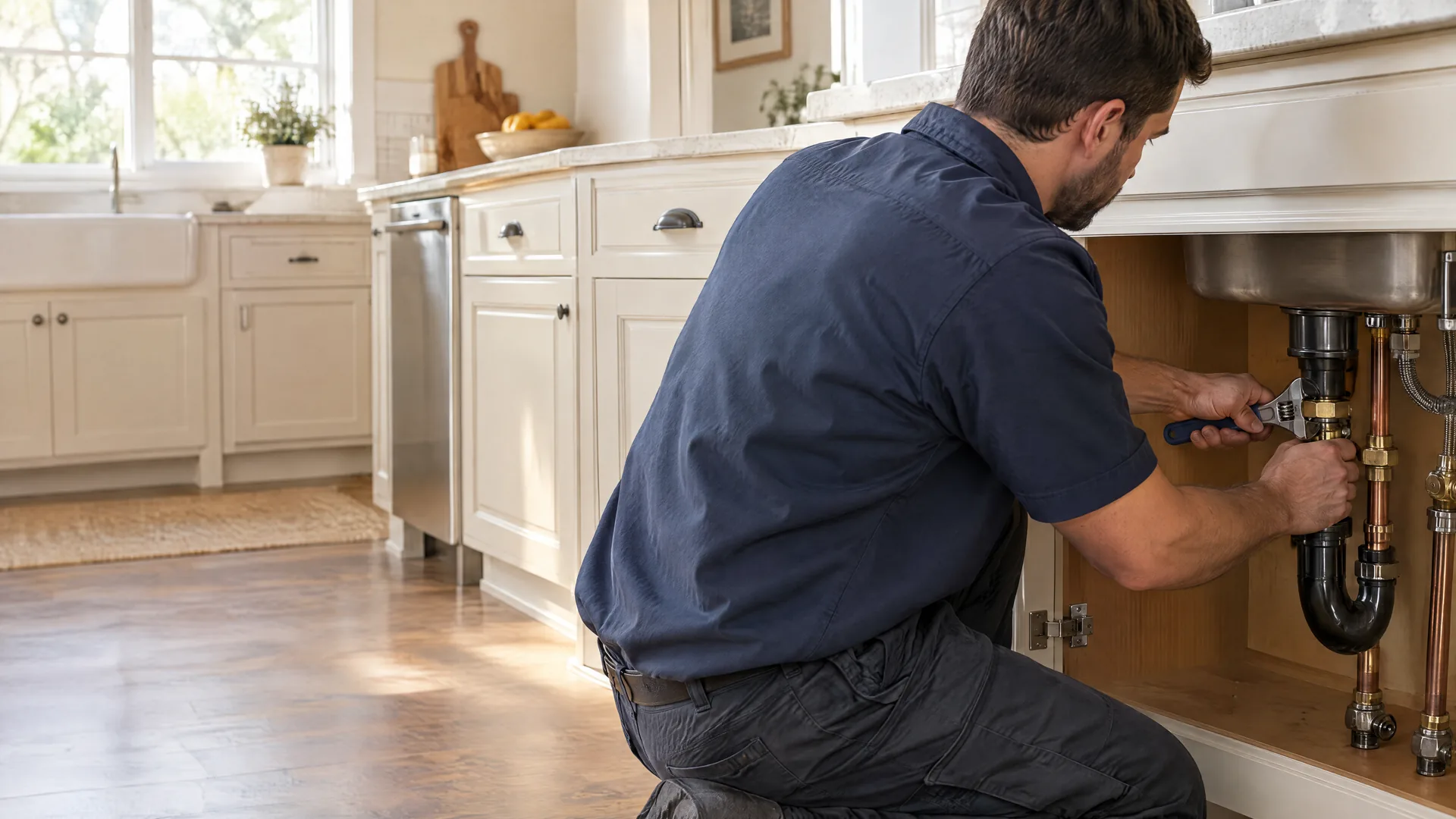
Plumber visit preparation Hallettsville homeowners complete does not require them to diagnose a leak, take apart a fixture, or decide what repair is needed. The best preparation is simpler: document the condition, make safe access possible, and give the service team enough context to start with the right questions. A few clear notes can save time during the visit and reduce the temptation to experiment with unfamiliar plumbing beforehand.
This checklist applies to a scheduled assessment for a stable concern. If there is active water, wastewater backup, a burning smell, or water near electrical equipment, safety and prompt qualified guidance come first. Do not wait for an appointment time if the condition presents immediate property risk.
Why the symptom pattern matters at the appointment
Consider a hypothetical kitchen sink that drains slowly after ordinary dishwashing, while the bathroom sink works normally. Food residue and grease can collect inside a kitchen drain and narrow the passage water must travel through. A restriction farther along a shared drain can instead affect several fixtures. A plumber needs to distinguish these locations before deciding whether the work belongs at a fixture, branch line or shared sewer.
That is why useful preparation is specific: tell the team which fixtures behaved normally, when the kitchen symptom started and whether a prior cleaning changed it. Do not run extra water to stage the problem or remove the trap before the visit. If you already used a chemical product, keep its container or take a label photograph from a safe location and disclose it before any drain is opened.
Drain chemicals can cause serious burns, as Poison Control explains. Do not add another product, mix cleaners or reach into standing drain water. Keep children and pets away. This safety information belongs in the service notes alongside the symptom because retained chemicals affect how a technician approaches the work.
Prepare access without touching the fault
For a stable under-sink concern, move dry cleaning supplies out of the cabinet only if no leaked water or chemicals are present. Leave valves, pipes and connected appliances untouched. Provide the room location, parking instructions and the name of an adult who can authorize assessment. Confirm whether the team wants existing photos before arrival.
When the appointment ends, ask what physical cause was confirmed, what remains uncertain, what work was performed and which recurrence would warrant a follow-up call. This turns preparation into a usable service record rather than a homeowner diagnosis.
Write down the problem in plain language
Start with what you observed, not what you believe caused it. Note which fixture, appliance, room, or pipe area is involved. Record when the change was first noticed, whether it is constant or intermittent, and whether normal use seems to affect it. A brief description such as “the kitchen sink drains slowly after normal use” is more useful than a guess about a blocked line or failed part.
Include any change in water temperature, water pressure, visible moisture, sound, odor, or fixture behavior that occurred around the same time. These facts may be relevant, but they do not establish a diagnosis. The technician can decide which observations matter after seeing the property and installed plumbing.
If you have photos or short videos that were taken safely, keep them available. Do not create new media by moving panels, getting close to a hot appliance, or entering a wet area. A normal-distance photo with a date can help explain an intermittent condition without increasing risk.
Keep a safe path to the work area
Clear ordinary items from the route to the fixture or equipment when it is safe to do so. Move laundry baskets, boxes, small furniture, or supplies that block access to a sink cabinet, water heater area, or visible plumbing. Do not move items through standing water, around electrical equipment, or beside a hot appliance. If the area is unsafe, tell the service coordinator rather than trying to make it accessible yourself.
Operation and maintenance instructions belong to the installed model. The A. O. Smith electric-water-heater manual provides one manufacturer-specific example; it is not the instruction book for a different appliance. Keep your own heater’s documentation available and leave unfamiliar controls, panels and energy connections untouched while arranging service.
If the scheduled concern involves hot-water performance or visible moisture near the unit, describe it as a water-heater repair concern when you call so the visit can start with the right scope.
Let the service team know about gates, pets, stair access, parking limits, or a fixture in a locked or occupied room. Practical access details are part of good preparation and can prevent a visit from starting with avoidable delays.
Gather records without filling in gaps
If you have previous plumbing invoices, warranty papers, equipment manuals, or a list of recent home work, keep them nearby. A prior record may give useful context about the property, but it does not prove the present concern has the same cause. Mark unknown dates or missing records as unknown rather than estimating them.
For a water heater, an accessible model label, installation record, or prior service note can be helpful. For a filtration system, keep the product manual and any documented maintenance record. Do not remove a cover or disconnect equipment to find a model number. A technician can identify information that is not safely accessible.
Tell the plumber if a fixture was recently replaced, if work occurred near the affected area, or if a property manager has already seen the issue. That context lets the assessment begin with a fuller history without turning timing into a conclusion.
Tell the household what to avoid before the visit
Once service is scheduled, let household members know which fixture or area is being monitored. Ask them not to use a problem fixture heavily, add chemical products, force a valve, or attempt an online repair. Several well-meaning attempts can change the original condition and make it harder to assess safely.
If a drain is slow, do not combine products or try to disassemble pipes under the sink. If a water-heater area has visible moisture, do not test controls, open panels, or alter gas or electrical connections. If a water-treatment system has a concern, do not bypass it or remove a housing to see what happens. The correct response depends on the actual equipment and condition.
It helps to leave a short note near the affected area, especially in a busy home. The note can say that service is scheduled and list the date, but it should not invite anyone to troubleshoot the problem in the meantime.
Identify the questions you want answered
A service visit is easier to follow when you have a few clear questions ready. Ask what was observed, what supports the recommendation, what should be documented afterward, and what signs should prompt another call. If a repair, maintenance step, or further assessment is proposed, ask what specific problem that action is intended to address.
You can also ask what a homeowner should not change on the system. A direct answer is valuable when the property has unfamiliar valves, controls, filtration equipment, or a water heater. The goal is to preserve a safe boundary between a homeowner’s observations and a professional’s assessment.
Avoid asking for guarantees that a single action will prevent every future issue. Plumbing systems have different histories, layouts, fixtures, and access conditions. A good explanation focuses on what can be verified at the property and what reasonable follow-up looks like.
Prepare for a useful conversation at the door
When the plumber arrives, begin with the short timeline and the location of the concern. Point out any safe, visible changes, then allow the technician to inspect the system without a running explanation of every theory you found online. Facts are the best starting point: what happened, when it changed, what was used, and whether the issue is active.
If the concern is intermittent, explain when it tends to occur and what you have already observed. A video or photo can help if it was taken safely. Do not recreate the problem by running appliances, cycling a water heater, or forcing a fixture to fail. The technician can advise on any property-specific test that is appropriate.
Keep the model information, invoices, and questions in one place. This lets the visit stay focused and gives you a written record of the recommendations afterward.
Plan the follow-up before the appointment ends
Before the visit is complete, ask what information should be saved. That might include the date, work performed, equipment model, maintenance recommendation, or conditions that should trigger a new call. Keep that record with your home documents so it is available if the issue returns.
If more than one household member manages the home, share the summary with them. A consistent record prevents duplicate calls, conflicting assumptions, or an old recommendation being applied to a new problem. For a rental property, send the property manager the documented outcome rather than relying on memory.
Hallettsville Plumbers can discuss professional plumbing services and explain the next step based on the actual home, equipment, and observations. A clear follow-up plan is more valuable than a generic promise about future performance.
A simple checklist for Hallettsville homeowners
Before a scheduled visit, make sure you can answer these questions:
- What changed, and when did you first notice it?
- Which fixture, appliance, or area is affected?
- Is water active, spreading, backing up, or near electrical equipment?
- What photos, records, or prior invoices are available?
- Has anyone used a product or changed equipment since the concern began?
- Are there access details, pets, gates, or parking limits the plumber should know?
This checklist does not diagnose the issue. It gives the technician a safe, usable starting point and helps prevent unnecessary experimentation before the appointment.
The right next step in Hallettsville
Plumber visit preparation Hallettsville homeowners use should be based on clear observations and safe access, not on a do-it-yourself repair attempt. Document the change, keep the area accessible only when it is safe, gather records, and ask for an explanation tied to the property.
Contact Hallettsville Plumbers to schedule help for a stable plumbing, water-heater, or water-treatment concern. If water is active, wastewater is backing up, or another immediate risk is present, seek prompt emergency plumbing guidance. The best service visit starts with facts and a safety-first approach.